


PriGrow I Medium
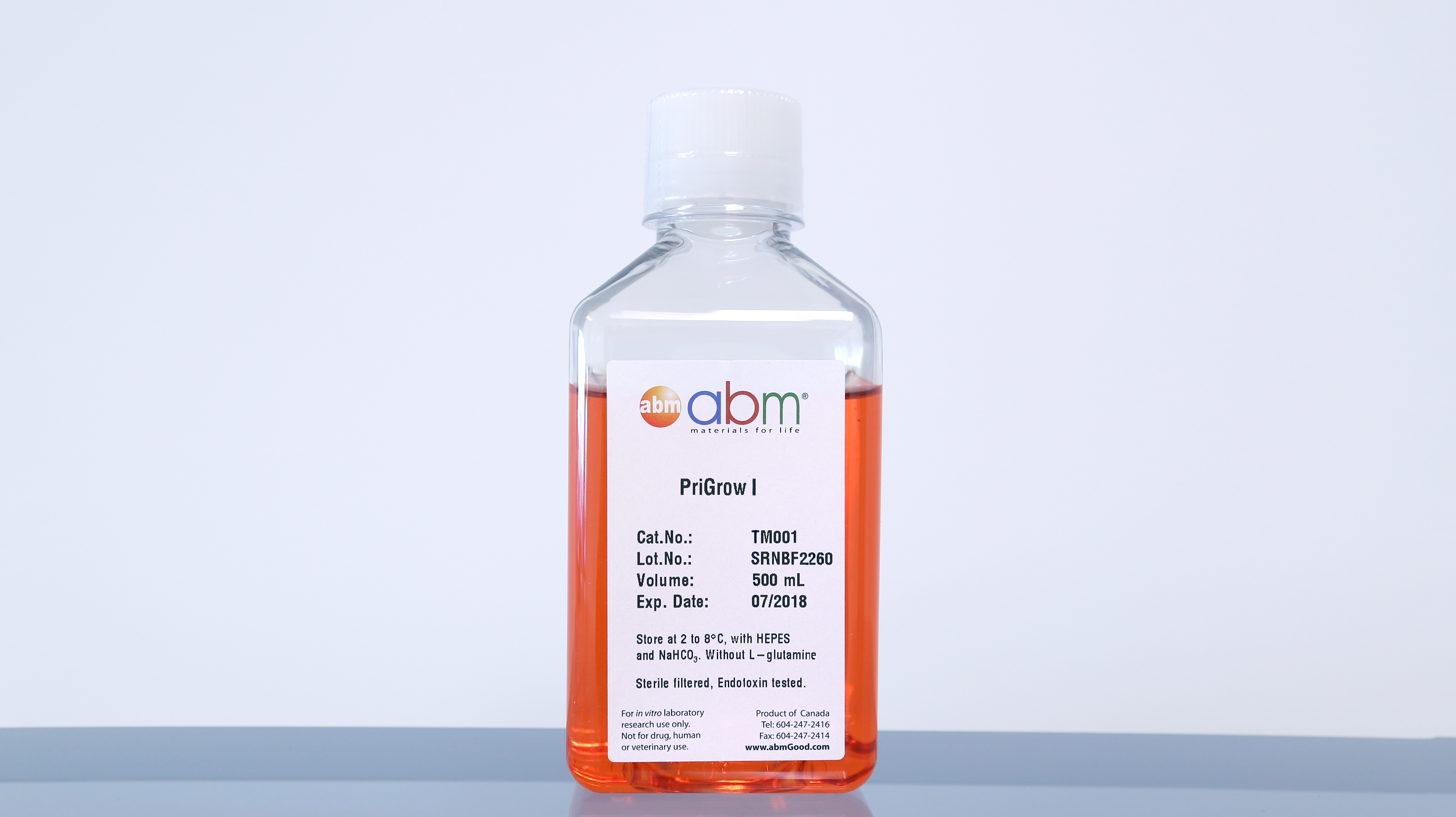
| Cat. No. | TM001 |
| Name | PriGrow I Medium |
| Description |
abm’s PriGrow Media Series for mammalian cell culture is composed of high-quality, specific formulations for optimal cell growth. |
| Unit | 500 ml |
| Endotoxin Level | ≤ 1EU/ml |
| Osmolarity | 270-310 mOsm/kgH2O |
| pH | 7.15-7.25 |
| Sterility | Negative |
| Appearance | Liquid |
| QC |
Each lot has been fully tested and optimized for its ability to support in vitro cell culture. The testing parameters include: adherence rate (where applicable), typical morphology, and metabolism of the tested cells. Additionally, the media has been tested for sterility, pH, osmolality and endotoxin levels. |
| Storage Condition | Store at 2-8°C. |
| Disclaimer |
|
| Material Citation | If use of this material results in a scientific publication, please cite the material in the following manner: Applied Biological Materials Inc, Cat. No. TM001 |
| Does freeze-thaw affect the performance of the transfection reagent? | |
|
Freeze-thaw does damage the transfection reagent slightly, at an approximate 5% loss.
If possible, test the agent with a GFP control first.
|
- Gong, B et al. "Exchange protein directly activated by cAMP plays a critical role in bacterial invasion during fatal rickettsioses." Proc Natl Acad Sci U S A. 110(48):19615-20 (2013). DOI: 10.1073/pnas.1314400110. PubMed: 24218580.
- Gong, B et al. "Compartmentalized, functional role of angiogenin during spotted fever group rickettsia-induced endothelial barrier dysfunction: evidence of possible mediation by host tRNA-derived small noncoding RNAs" BMC Infect Dis. 13:285 (2013). DOI: 10.1186/1471-2334-13-285. PubMed: 23800282.
- Gong, B et al. "Rickettsiae induce microvascular hyperpermeability via phosphorylation of VE-cadherins: evidence from atomic force microscopy and biochemical studies" PLoS Negl Trop Dis 6(6):e1699 (2012). DOI: 10.1371/journal.pntd.0001699. PubMed: 22720111.
- Gong , B. et al. "METHODS OF TREATING RICKETTSIA USING EXCHANGE PROTEINS DIRECTLY ACTIVATED BY CAMP (EPACS) INHIBITORS" Patent : (2014). PubMed: US20140348853.
- Hansen, K et al. "Feasibility Investigation of Cellulose Polymers for Mucoadhesive Nasal Drug Delivery Applications" Molecular Pharmaceutics 8:2732-2741 (2015). PubMed: 26097994. Application: cell culture.
- Prince, J et al. "MicroRNA-9 inhibits hyperglycemia-induced pyroptosis in human ventricular cardiomyocytes by targeting ELAVL1" Biochemical and biophysical research communications 4:423-429 (2016). DOI: doi: 10.1016/j.bbrc.2016.02.065. Application: Culture.
- Lai, IL et al. "Targeting the Warburg effect with a novel glucose transporter inhibitor to overcome gemcitabine resistance in pancreatic cancer cells" Carcinogenesis 10:2203-2213 (2014). DOI: doi: 10.1093/carcin/bgu124. PubMed: 24879635 . Application: Culture.
- Jeyabal, P et al. "MicroRNA-9 inhibits hyperglycemia-induced pyroptosis in human ventricular cardiomyocytes by targeting ELAVL1" Biochem. Biophys. Res. Commun. 4:423-429 (2016). DOI: 10.1016/j.bbrc.2016.02.065. PubMed: 26898797. Application: Culture.
- Li, Y., Hong, J., Jung, B.-K., Oh, E., & Yun, C.-O. "Oncolytic Ad co-expressing decorin and Wnt decoy receptor overcomes chemoresistance of desmoplastic tumor through degradation of ECM and inhibition of EMT" Cancer Letters 459:15–29 (2019). DOI: 10.1016/j.canlet.2019.05.033.
- Liu, Q., Wang, X., Liu, X., Kumar, S., Gochman, G., Ji, Y., ... & Jiang, J. "Use of Polymeric Nanoparticle Platform Targeting the Liver To Induce Treg-Mediated Antigen-Specific Immune Tolerance in a Pulmonary Allergen Sensitization Model" ACS nano 13(4):4778-4794 (2019).
- Liu, Q., Zhao, Y., Xing, H., Li, L., Li, R., Dai, J., … Fang, S. "The role of R-spondin 1 through activating Wnt/β-catenin in the growth, survival and migration of ovarian cancer cells" Gene 689:124–130 (2019). DOI: 10.1016/j.gene.2018.11.098.
- Quintela, M., Sieglaff, D. H., Gazze, A. S., Zhang, A., Gonzalez, D., Francis, L., … Conlan, R. S. "HBO1 directs histone H4 specific acetylation, potentiating mechano-transduction pathways and membrane elasticity in ovarian cancer cells" Nanomedicine: Nanotechnology Biology and Medicine:17 (2019). DOI: 10.1016/j.nano.2019.01.017.